Author

Marcy Rio

Browsing

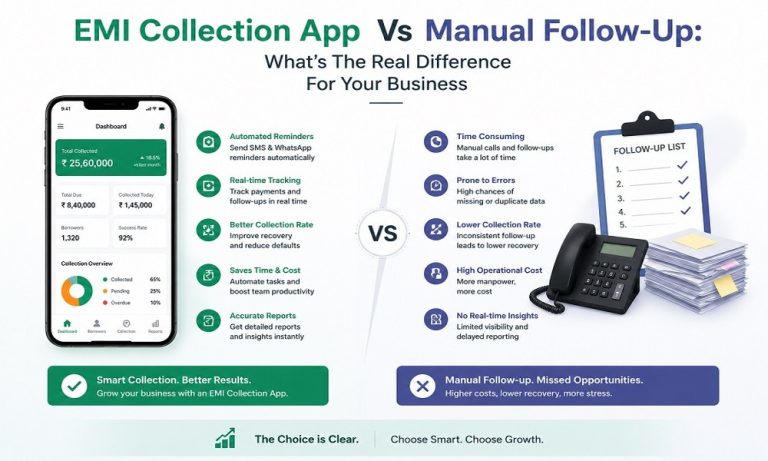
Running a business that offers EMI-based sales in India means you are also running a collections operation. And how well you manage that side has a direct impact on your cash flow, your team’s bandwidth, and your customer relationships. For years, manual follow-up was the only option. Today, the EMI collection app has changed that – and the difference between the two is larger than most business owners expect.

What Manual Follow-Up Actually Looks Like

Manual follow-up sounds straightforward, but in practice it is exhausting. Your team is making calls, sending WhatsApp messages, maintaining Excel sheets, and chasing customers who either do not pick up or promise to pay “by evening” – every day.

The problems compound quickly. There is no centralised record of who was contacted, when, and what was said. Follow-up depends entirely on individual team members, which means when someone is on leave, collections slip. And scaling this process as your business grows means hiring more people – at a higher cost with no guarantee of better results.

In India’s retail and lending ecosystem, where EMI portfolios can run into hundreds of active accounts, manual follow-up simply was not built for this volume.

What an EMI Collection App Brings to the Table

An EMI collection app centralises and automates the entire follow-up process. Instead of relying on a team member to remember who needs a reminder today, the app handles it – automatically sending payment nudges via SMS, WhatsApp, or in-app notifications based on due dates and account status.

Every interaction is logged. Every payment is tracked in real time. The moment a customer pays, the record updates – no manual entry, no confusion. For business owners, this means a live view of the entire portfolio at any given moment.

A well-built EMI collection app also segments accounts by risk, allowing your team to focus energy where it is actually needed rather than calling everyone with the same urgency.

The Numbers Behind the Difference

The gap between an EMI collection app and manual follow-up becomes very clear when you look at cost and recovery rates. Manual follow-up typically costs ₹35-₹80 per customer contact once you factor in agent time and overhead. An EMI collection app brings that figure down to ₹4-₹12 per contact.

Recovery rates follow the same pattern. Businesses on manual follow-up tend to see early-bucket recovery rates of 55-65%. Those using an EMI collection app consistently report 72-88%. That gap, across hundreds of accounts, is a significant difference in monthly revenue recovered.

Where Manual Follow-Up Still Has a Role

An EMI collection app handles volume efficiently but cannot replace human judgment in every case. High-value defaults, customers facing genuine financial hardship, or accounts that need restructuring – these still benefit from a personal conversation.

The most effective businesses are not replacing their teams entirely. They are using the app for routine follow-up at scale and freeing their people to focus on accounts that genuinely need attention.

Conclusion

The difference between an EMI collection app and manual follow-up is not just operational – it is financial. Lower cost per contact, higher recovery rates, real-time visibility, and the ability to scale without adding headcount make the app the stronger choice for any business managing an active EMI portfolio. Manual follow-up had its time. For businesses serious about collections efficiency in today’s market, adopting an EMI collection app is no longer optional – it is essential.

The landscape of modern trading has evolved from manual entries to a digital arena where milliseconds determine the gap between profit and loss. As markets become more efficient, the technical infrastructure behind a trader’s desk has become just as vital as the strategy itself. Serious traders are migrating their operations to dedicated environments to ensure their systems never miss a beat.

The Foundation of Constant Connectivity

One of the most critical upgrades a trader can make is moving away from reliance on local PC toward VPS hosting. A Virtual Private Server provides a dedicated, remote environment that remains powered on 24/7, independent of your local power supply or internet stability. By hosting your platform on a server located in a high-tier data center, you eliminate the risks of unexpected updates, hardware crashes, or home Wi-Fi drops that could lead to catastrophic execution errors during volatile market moves.

Built for Performance

For those seeking the gold standard in this field, TradingVPS has emerged as a premier brand specifically engineered for the financial community. Unlike generic hosting providers, TradingVPS optimizes its hardware for high-frequency data throughput and ultra-low latency. Their servers are strategically positioned near major exchange hubs like Equinix data centers in New York and London. This geographical advantage ensures the physical distance your signal travels is minimized, effectively “shaving off” milliseconds from your execution time.

The Demands of Algorithmic Trading

This transition to specialized infrastructure is particularly vital for the rise of algorithmic trading. This method involves using computer programs and pre-defined instructions to place trades at speeds and frequencies that a human simply cannot match. Because these algorithms scan multiple markets and execute orders based on complex mathematical models, any delay in the data feed can result in “slippage,” where the trade is filled at a price different from the one intended.

Precision in Automation

In the world of algorithmic trading, the system must be active and connected to the exchange during all trading hours. If a bot is running a mean-reversion strategy, it needs to process real-time price action and respond instantly. A VPS ensures the algorithm has a “clean” environment with dedicated CPU and RAM resources, preventing the lag that occurs when a personal computer runs trading software alongside everyday applications.

Enhanced Security and Redundancy

Beyond speed, a VPS provides professional-grade security that home setups simply cannot match. Equipped with industrial firewalls and automated backups, these servers shield your data from local vulnerabilities. Most importantly, a VPS offers essential redundancy; even during a local power outage or internet failure, your trading environment remains active in the cloud. This ensures your strategies continue managing positions 24/7, providing peace of mind and protecting your capital from hardware-related disruptions.

Conclusion

A VPS is no longer a luxury; it is an essential tool for market competition. By leveraging the low-latency power of brands like TradingVPS, traders can focus on refining their edge while the infrastructure handles the heavy lifting of execution. In a game of speed, staying ahead starts with where your platform lives.

If you are heading into ACCA resit exams, you do not need a fresh start. You need a better start.

Most resits fail for the same reason as the first sitting. Not because you forgot everything. You usually fail because your exam execution did not improve. You still misread requirements. You still over-write early. You still run out of time. You still leave professional marks on the table.

Week one is where you break that pattern. This post gives you a simple week one reset plan that focuses on the behaviours that make you pass ACCA exams. It is written for ACCA SBR but the method works across papers. If you want a broader base plan to support the sitting, use this ACCA exam success guide alongside the week one schedule.

The mistake most resit candidates make in week one

They go back to reading.

Reading feels safe because it does not expose weaknesses. Writing does. But the exam is writing under time pressure. So week one should be built around writing and review, not endless notes.

Here is the truth that helps most resitters.

You do not need more content first. You need more control first.

Control means you keep moving through the paper. You answer the requirement. You conclude. You finish.

That is how you stop failing ACCA exams.

What week one must achieve

Week one has only three goals:

  1. Rebuild exam rhythm with timed writing
  2. Identify the two or three habits that cost marks
  3. Fix those habits with targeted rewrites

If you do that, week two becomes easier. Your confidence improves because you can see change on the page.

This also answers the question many candidates ask after a fail, which is how difficult is passing ACCA. Passing is hard when you repeat the same habits. It becomes manageable when you change them.

Start with a honest diagnosis

Before you plan any revision, take 10 minutes and answer these questions in plain English.

  • Did I finish the paper last time
  • Did I spend too long on the first question
  • Did I lose marks for not answering the verb in the requirement
  • Did I miss professional marks because my answer lacked structure and conclusions
  • Did I avoid topics and then panic when they appeared

This diagnosis is your map. If you do not diagnose, you will drift back into old habits.

The resit rule that changes everything

One hour of timed writing beats three hours of reading in week one.

That is not motivational talk. It is practical. The exam rewards output. Output is your script.

So the plan below puts you in timed conditions early. It also includes a debrief method that tells you exactly what to fix.

Your week one plan

This is the only bullet list in the post. It gives you a full week structure you can follow. Keep the sessions short and strict.

  • Day 1
    Sit a 40 minute timed set using ACCA sample exams or exam style questions. Do not pause. Afterward, mark yourself for structure and relevance, then rewrite one weak paragraph into 8 to 10 lines.
  • Day 2
    Do two 15 minute timed mini requirements on different topics. Focus on reading the requirement properly and concluding each part. End with a 10 minute debrief on timing and structure.
  • Day 3
    Sit a 60 minute mixed set. Stop exactly when time ends. Mark your work, then write a short action list of two habits to fix in the next attempt.
  • Day 4
    Do one 25 minute professional marks drill. Write as if you are advising an audit committee. Make two clear recommendations and a conclusion. Rewrite the weakest paragraph.
  • Day 5
    Sit another 40 to 60 minute timed set. Apply your two fixes from Day 3. Mark for improvement, not perfection.
  • Day 6
    Do a light technical refresh on two weak areas, then write one short applied paragraph for each. Keep it strict and practical.
  • Day 7
    Review the week. Choose your top three errors and write one sentence for how you will prevent each one next week. Then rest.

That is week one. It is strict, but it is not heavy. It is designed to change behaviour fast.

The marking method that resit candidates rarely use

Resitters often mark for content only. That misses the real problem. Markers do not only reward knowing the rule. They reward answering the task.

In week one, mark your work using two lenses.

First lens is relevance.

Did you answer what was asked
Did you apply to scenario facts
Did you reach a conclusion

Second lens is execution.

Did you finish the time
Did you overspend early
Did you keep paragraphs short and clear

If you failed on execution, content is not your first fix. Execution is.

This is why a good ACCA tutor online can help. Strong feedback often points out that your answer was not wrong, it was just not focused on the requirement. That is a performance issue.

The one paragraph rewrite that creates fast improvement

The fastest resit improvement comes from rewriting one paragraph per day.

Do not rewrite full answers. That is slow and you will quit.

Rewrite only the paragraph that lost marks for an obvious reason:

  • it was too vague
  • it did not apply to the facts
  • it did not answer the verb
  • it had no conclusion

Use this structure:

Issue – Rule – Apply – Conclude

Keep it to 8 to 10 lines. Cut filler. Add one scenario fact. Add one clear conclusion line.

If you do this daily for a week, your writing tightens. Your confidence rises. Your score usually follows.

How to rebuild time control in week one

Time control is the biggest difference between pass and fail in SBR ACCA.

Most candidates who fail do not finish. They might be strong technically, but they leave too many marks untouched.

In week one, adopt a simple rule.

When the time ends for a part, you move on.

If you cannot move on, you will fail again. It is that simple.

You do not need to feel ready. You need to behave like a candidate who finishes the paper.

This is the core of ACCA exam success.

The resit start line you should use in every question

Many candidates start with background. That wastes time and often scores nothing.

Start like this instead:

  • write headings that match the requirement
  • write one issue sentence for each heading
  • then write one applied point
  • then conclude

This approach works for every topic.

It works for a technical requirement like IFRS 11.
It works for financial instruments and derivative accounting.
It works for a narrative requirement about governance.

It also makes you sound like a professional, which is where professional marks come from.

Handling weak topics without avoiding them

Resit candidates often have two or three topics they avoid. In SBR, common avoid areas include complex group issues, certain financial instruments points, and judgement heavy narrative requirements.

Avoidance feels safe. It is also why you fail again.

In week one, you do not need to master your weak topics. You need to face them briefly and write something under time pressure.

That means you write short applied paragraphs on topics like:

  • IFRS 11 classification based on rights and obligations
  • the outline of a cash flow hedge and where gains and losses go in derivative hedge accounting
  • a simple commodity hedge accounting example in words
  • how a current issue affects cash flows and impairment forecasts

You do not need a perfect answer. You need to practise writing a passable answer under time pressure.

That is how you reduce panic.

The best resit mindset

If you are resitting, your goal is not to prove you are clever. Your goal is to bank marks.

That means:

  • you answer what is asked
  • you use scenario facts
  • you conclude
  • you move on
  • you finish the paper

This mindset also improves your ACCA motivation because it reduces the sense of being overwhelmed. You have a simple job to do in each requirement.

How to use support properly in a resit

Support only helps if it improves your scripts.

If you are using online ACCA tuition or you are looking for ACCA tuition near me, keep your decision simple. Choose the route that gives you:

  • timed practice
  • script feedback
  • clear fixes you can apply in the next attempt

That is why many candidates use an ACCA tutor for marking rather than for lectures. Marking changes behaviour fast.

If you want structure and deadlines, a course can help because it forces output. If that fits your style, look at the ACCA SBR course options and use week one to build the habit of submitting timed work.

What to do if you still feel overwhelmed

Resit stress is normal. The fix is to shrink the tasks.

If a full mock feels too heavy in week one, do partial mocks. Do a 40 minute set. Do two 15 minute mini requirements. Do short rewrites.

Small strict sessions build momentum. Momentum leads to confidence. Confidence leads to consistency.

That is the real meaning of staying motivated during ACCA exams. You keep showing up and producing output.

The quick test for whether week one worked

At the end of week one, you should be able to answer these questions with confidence.

  • Am I finishing timed sets more often
  • Are my answers shorter and more applied
  • Do I conclude more often
  • Have I identified my top two habits to fix next week
  • Do I feel more in control of exam rhythm

If the answer is yes, week one has done its job.

If the answer is no, do not panic. Tighten the plan. Make the timed sets smaller but stricter. Keep the rewrites. Consistency beats intensity.

What comes after week one

Week one is about behaviour change. Week two is about building depth. You increase timed work and you target weak areas more deliberately.

But do not skip week one. If you skip it, you drag old habits into the resit and you get the same result.

Final calm reminder

Resits are won through execution.

If you want to stop failing ACCA exams, week one should not be a reading marathon. It should be a strict writing and review week. Timed sets. Clear structure. Short applied points. Conclusions. Rewrites.

Do that for seven days and your next sitting will already feel different.

Many banks provide the account holders the option to track their transactions online in an effort to maintain transparency. This helps in properly managing the available funds and spot any unnecessary transactions or fraudulent transactions. In this guide we have cover on how you can check bank statement online and common queries regarding your bank statement.

What is an Online Bank Statement?

An online bank statement is an electronic version of your bank statement that displays information like deposits, withdrawals, transfers, etc., within a specific time frame.

While traditional bank statements are printed on paper, an online bank statement is easily accessible at any time of the day, especially when it comes to tracking expenses related to your savings account.

How to Check Bank Statement Online

The steps to check the bank statement may vary slightly for different banks, but the process as a whole is quite similar.

1. Login to Your Bank’s Website/App

First, you need to visit the official website of the bank you are associated with or open the mobile app of the bank.

2. Go to the Accounts Section

Once you are successfully logged in to the bank’s website, you need to go to the section where you can view your accounts. This section will probably be labelled as “Accounts” or “My Accounts.”

3. Select Your Account

Once you are in the accounts section, you need to select the relevant savings account/current account.

4. Click on ‘View Statement’ or ‘Account Statement’

Once you select the relevant account, you will see the option to view the statement of the bank.

5. Download Statement

In case you are curious to know how to download bank statement online, you need to see the download option on the page. The statement will probably be in the form of a PDF file.

Other Alternative Methods to Access Your Statements

Apart from internet banking, there are a few more alternative ways to access your bank statement:

  • Mobile Banking Apps: Many users prefer using mobile banking apps to access their bank statements.
  • Email Statements (E-Statement): Many banks provide this facility to their users. Banks send monthly statements to your email account.
  • SMS/Mini Statements: These are available if you want a quick look at your recent transactions.

Benefits of Checking Bank Statements Online

There are several benefits to accessing your bank statement online:

  • Saving Time: There is no need to spend time traveling to your bank to access your bank statement. You can access your bank statement anytime, anywhere.
  • Better Tracking: Regularly keeping track of your bank statement will enable better management of your expenses.
  • Secure Record: Your bank statement is stored securely, and whenever required, it is easily available.

It is always better to remain aware of changes in savings account interest rates, as this affects your savings.

Safety Tips While Accessing Bank Statements

Although it is safe to use internet banking, some basic steps should be followed:

  • Only use official websites.
  • Avoid using internet banking on shared computers.
  • Do not share your login ID or OTP with anyone.
  • Log out after using internet banking.

These steps will ensure your safety while using internet banking services.

What If You Don’t Have Online Banking?

If you haven’t started using internet banking, then there is no need to worry because this service is easily available with online account opening services. Once your account is opened, you can start using internet banking services and access your online bank statement immediately.

Conclusion

Today, checking your bank statement online is not a difficult task at all. With just a few steps, you can easily view, download, and manage your financial information right from the comfort of your home.

Whether it is checking your expenses, confirming transactions, or just keeping an eye on your savings account, the entire process is quite smooth with online bank statements.

Frequently Asked Questions

Q1) When are the monthly e-statements available for download?

By the 5th of each month, account holders can receive the monthly e-statements. These statements are available for download for access up to 7 years of history via app or net banking.

Q2) What is the cost of requesting online bank statements?

For digital statements, banks provide bank statements for free, in the case of physical statements charges may incur.

Q3 What if I see some errors in my statement?

You can raise disputes via app or email of the bank’s customer support. Banks are mandated to resolve disputes within 30 days of the complaint as per RBI guidelines.

Online lending has become a mainstream option in the UK, offering fast applications, quick decisions, and funds that can arrive the same day. But with convenience comes a fair question: is it actually safe to take a loan online?

The short answer is yes-if you choose carefully and understand what to look for. This guide explains how online loans work in the UK, what makes them safe (or risky), and how to protect yourself before you apply.

How Online Loans Work in the UK

Online lenders allow you to complete the entire borrowing process digitally:

  • Fill in an application form
  • Receive an instant or same-day decision
  • Sign the agreement electronically
  • Get funds transferred to your bank account

This speed is useful in emergencies, but it also means you need to be extra attentive when reviewing terms and choosing a provider.

Are Online Loans Regulated in the UK?

Yes. Legitimate lenders in the UK must be authorised and regulated by the Financial Conduct Authority (FCA).

This means they are required to:

  • Assess whether you can afford the loan
  • Clearly disclose all fees and interest
  • Treat customers fairly
  • Provide support if you experience repayment difficulties

Before applying, always check that the lender appears on the FCA register. This is one of the most important steps in staying safe.

Key Signs of a Safe Online Loan

A trustworthy lender or platform will usually have the following characteristics:

1. Transparent pricing
All costs-interest, fees, and total repayment-are clearly displayed upfront.

2. Clear terms and conditions
You can easily understand repayment schedules, penalties, and your rights.

3. Secure website
Look for “https” in the URL and proper data protection measures.

4. No pressure tactics
Legitimate lenders give you time to review your decision.

If any of these elements are missing, it’s worth reconsidering.

Potential Risks to Watch Out For

While many lenders are legitimate, there are still risks associated with online borrowing:

  • Hidden fees in unclear contracts
  • Unlicensed lenders operating outside UK regulations
  • Overborrowing due to easy access
  • Short repayment deadlines that can lead to penalties

Being aware of these risks is key to avoiding financial problems.

How to Choose the Right Loan Safely

Instead of applying directly with the first lender you find, it’s smarter to compare options.

Using platforms like Nudge Loans allows you to review different lenders in one place and better understand your choices before committing. This reduces the likelihood of choosing a loan with poor terms.

If you’re specifically considering short-term borrowing, it’s especially important to compare costs and repayment timelines carefully. You can explore options such as short-term loans to see how different offers vary.

Are Short-Term Online Loans Safe?

Short-term loans are commonly used for urgent expenses, but they require extra caution.

They are generally safe when:

  • The lender is FCA-regulated
  • You understand the full repayment amount
  • You can repay on time

However, they can become expensive if misused, especially if repayments are delayed or rolled over.

Tips for Staying Safe When Borrowing Online

These simple steps can make a significant difference in your overall experience.

Final Thoughts

Taking a loan online in the UK can be safe, convenient, and efficient-but only when approached responsibly. Regulation by the Financial Conduct Authority provides a strong layer of protection, but the responsibility still lies with the borrower to make informed decisions.

By choosing regulated lenders, comparing your options, and understanding the full cost of borrowing, you can confidently use online loans as a practical financial tool-without unnecessary risk.

Traditionally, fixed-income investments have been regarded as safe but unexciting-reliable sources of income, yet limited by their illiquidity and accessibility. That narrative is rapidly evolving.

A new financial innovation is reshaping the bond market: tokenized treasuries. By merging the transparency of blockchain with the trust of government-issued debt, tokenized treasuries are becoming a transformative force for both institutional and retail investors seeking yield, liquidity, and stability in a volatile market landscape.

What was once a sleepy corner of finance is now attracting fintech giants, asset managers, and even crypto-native platforms, all competing to offer a more flexible, efficient way to access US Treasury yields through blockchain-based tokens. This isn’t just another crypto fad.

Tokenized treasuries may well redefine how bonds are issued, traded, and held-ushering in a new era for fixed-income investing.

How Treasuries Became Tokenized

Treasuries have long been regarded as one of the safest and most liquid assets available, particularly during periods of economic volatility. Historically, however, the market has been constrained by cumbersome settlement times, high barriers to entry, and limited accessibility across borders. Tokenization-converting the rights to an asset into a digital token on a blockchain-breaks down these barriers.

Tokenized treasuries are essentially digital versions of U.S. government bonds issued and traded on blockchain platforms. Each token represents a fractional or full interest in a real-world Treasury instrument, such as a T-bill or note, with on-chain mechanisms handling issuance, trading, and settlement. Smart contracts automate interest payments, custody, and compliance, reducing friction and counterparty risk.

Recent growth in this sector has been explosive. The total value of tokenized U.S. Treasury products on public blockchains surged past $850 million, driven by demand from crypto-savvy investors looking for stable, yield-bearing assets amid persistent inflation and tightening credit conditions.

Many startups and legacy institutions are all pioneering tokenized Treasury products that integrate seamlessly with Web3 wallets and platforms.

Recommended Read: Analyzing the Impact of Tokenomics on Digital Asset Valuation

Article image

Why This Matters: Liquidity, Transparency, and Global Reach

Tokenized treasuries solve three fundamental problems plaguing traditional bond markets: lack of transparency, limited access, and sluggish settlement.

1. Improved Liquidity

Traditional fixed-income instruments are notorious for low secondary market liquidity. Settlement times of T+2 or longer deter high-frequency trades and smaller players.

Tokenized treasuries, however, settle nearly instantaneously on-chain, creating 24/7 liquidity opportunities for participants worldwide.

Decentralized exchanges (DEXs) and institutional-grade trading platforms now enable the real-time buying and selling of these assets, unlocking capital that was previously trapped in bureaucratic settlement cycles.

2. Enhanced Transparency

Blockchain’s immutable and auditable ledger brings unprecedented transparency to Treasury holdings. Investors can verify ownership, yield accrual, and payment schedules without relying on third parties. This transparency is particularly attractive to younger, digitally native investors accustomed to real-time data and open financial systems.

3. Global Accessibility

Traditionally, access to U.S. Treasuries required brokerages, bank accounts, and often, a minimum investment threshold. With tokenization, these requirements are dramatically reduced.

Tokenized treasuries can be purchased through DeFi interfaces using stablecoins such as USDC or USDT, enabling participation from investors in emerging markets who may lack access to formal banking infrastructure. By reducing reliance on intermediaries, these digital instruments democratize access to one of the world’s most trusted asset classes.

DeFi and Tokenized Treasuries: A Symbiotic Future?

Decentralised Finance (DeFi) platforms are integrating tokenized treasuries into their protocols as “real-world assets” (RWAs), bridging the gap between traditional finance and blockchain-based applications.

For example, protocols like MakerDAO and Aave are incorporating tokenized Treasuries into collateral pools to back stablecoins or enable borrowing against them.

This merging of DeFi with conservative fixed-income instruments creates a fascinating dynamic: high liquidity with low volatility. For the first time, DeFi users can park their capital in on-chain treasury-backed tokens, earning predictable yields without exiting the ecosystem.

Such integration also makes DeFi platforms more sustainable, reducing reliance on speculative crypto lending and improving long-term protocol health. This hybrid future isn’t theoretical-it’s already here.

Lowering Barriers, Democratizing Access

Historically, retail investors needed significant capital or intermediary platforms to access Treasury products. With tokenized treasuries, anyone with a crypto wallet can gain exposure to government bonds with as little as $10.

Fractionalization removes geographic and economic barriers. A user in Southeast Asia can hold a sliver of a US Treasury bond without needing to engage with a broker or wire funds internationally. The implications for financial inclusion are enormous, especially in regions with unstable currencies or limited access to global financial instruments.

The Risks and Limitations

Despite the enthusiasm, tokenized treasuries are not without challenges:

  • Regulatory uncertainty remains the biggest obstacle, especially for global retail access.
  • Smart contract vulnerabilities can lead to technical risks if platforms are not rigorously audited.
  • Liquidity pools for secondary markets are still developing, with some products experiencing low trading volumes.
  • Interoperability issues between blockchain networks can hinder broader adoption.

That said, these growing pains are not dissimilar to those faced by ETFs two decades ago-a now $10 trillion market.

Introduction: Weather as a Defining Risk

Queensland’s climate is both a blessing and a challenge. While the state enjoys abundant sunshine and coastal beauty, it also faces recurring natural hazards such as cyclones, floods, and hailstorms. For strata schemes, these environmental realities make insurance not just a legal requirement but a critical resilience tool.

The Climate Challenge for Strata Schemes

Cyclones and Coastal Risks

Northern and coastal regions of Queensland are particularly vulnerable to cyclones. High winds and storm surges can cause extensive damage to shared property, making insurance coverage essential for recovery. Historical events, such as Cyclone Debbie in 2017, demonstrated how quickly communities can be disrupted and how costly rebuilding can be without adequate coverage.

Flooding and Urban Vulnerabilities

Urban centres like Brisbane face flood risks due to river systems and heavy rainfall. The 2011 floods highlighted the vulnerability of urban infrastructure, including multi-unit complexes. Strata schemes in flood-prone areas must account for these risks when selecting insurance policies, ensuring coverage extends to water damage and structural repairs.

Insurance as a Resilience Mechanism

Coverage Beyond Compliance

While legislation mandates insurance for common property, resilience requires going further. Comprehensive coverage ensures that strata schemes can recover quickly after climate events, protecting both property values and community stability. This includes considering optional add-ons such as flood or cyclone-specific coverage, which may not be automatically included in standard policies.

Financial Protection Against Extreme Events

Insurance provides financial protection against the escalating costs of climate-related damage. Without adequate coverage, owners could face crippling repair bills, undermining both individual investments and collective governance. For example, rebuilding after a cyclone can cost millions, far beyond the capacity of individual owners to manage.

Practical Strategies for Climate Resilience

Preventive Infrastructure

Investing in resilient infrastructure, such as flood barriers or cyclone-resistant materials, reduces risk and may influence insurance terms. Preventive measures demonstrate proactive governance and protect residents. Complexes that upgrade roofing materials or install stormwater management systems often see reduced claims, which can help stabilise premiums.

Risk Assessment and Planning

Bodies corporate should conduct regular risk assessments to identify vulnerabilities. Planning for climate risks ensures that insurance policies align with actual exposure. This may involve engaging engineers or risk consultants to evaluate structural resilience and recommend improvements.

Expanding Knowledge Resources

Understanding how strata insurance interacts with climate risks requires accessible information. Guidance on residential strata insurance obligations in Queensland’s climate-sensitive regions helps owners and managers make informed decisions.

The Role of Insurers in Climate Adaptation

Adjusting Premiums

Insurers often adjust premiums based on geographic risk profiles. Complexes in cyclone-prone or flood-prone areas may face higher costs, reflecting the increased likelihood of claims. This can create financial strain but also incentivises bodies corporate to invest in resilience.

Encouraging Resilient Practices

Some insurers reward proactive risk management, such as installing resilient materials or maintaining safety systems. These incentives encourage bodies corporate to invest in climate adaptation, aligning financial and environmental goals.

Long-Term Implications for Property Owners

Value Preservation

Adequate insurance ensures that properties can be repaired or rebuilt after climate events, preserving long-term value. For investors, this stability is crucial in maintaining rental yields and resale potential.

Market Confidence

Buyers and investors are increasingly aware of climate risks. Robust insurance coverage signals responsible governance and enhances market confidence in strata schemes. Complexes that demonstrate resilience often attract stronger demand, even in high-risk regions.

Conclusion: Insurance as Climate Infrastructure

In Queensland, strata insurance is more than compliance; it is climate infrastructure. By integrating resilience strategies, preventive measures, and comprehensive coverage, strata schemes can navigate the challenges of a climate-sensitive environment. For owners and investors, this approach ensures both compliance and long-term protection in a state where weather is a defining force.

Many people want a clearer market direction before placing money at risk. Smart systems now support better judgment through data-based insight and fast signals. New platforms assist planning, timing, and risk control. They also improve discipline during uncertain moves. With correct leverage usage, early planning becomes balanced rather than rushed. These solutions support both fresh participants and skilled planners who want reliable pattern checks without confusion or overload.

Chart Pattern Recognition

This method highlights repeated shapes on price screens using visual rules. It helps people notice rising paths, falling moves, or side movement clearly. By showing history-based forms, it supports early decision-making. Many rely on this approach to confirm entries exist and risk control using clear visual guidance.

Indicator-Based Signals

Indicators transform price information into simple lines or values. They point out momentum strength or weak spots without complex steps. When used correctly, they reduce guesswork. These signals support timing choices and trend confirmation. They also help avoid emotional moves by showing structured signals built from past behavior.

Volume Tracking Systems

Volume tracking shows how much interest exists behind price movement. Strong volume often supports trend strength while weak volume warns of risk. This tool helps confirm breakouts or reversals. It gives clarity on whether price changes are backed by strong action or temporary interest.

Time Series Analysis

A time series study looks at price changes across periods. It helps identify cycle repetition and seasonal behavior. By studying time patterns, people can estimate likely movement paths. This tool supports planning based on rhythm rather than impulse. It also improves patience by highlighting expected movement ranges.

Market Sentiment Tools

Sentiment tools gather public mood from various sources. They show whether optimism or fear dominates. Extreme mood often signals turning points. This approach helps balance technical views. When combined with price data, it adds context. It reduces bias by showing how others currently react to changes.

Trend Strength Measurement

Trend strength tools calculate how firm a movement is. They separate strong moves from weak ones. This helps avoid chasing fading paths. By using strength values, people choose safer timing. These tools also help manage exits when momentum starts slowing without a clear price reversal yet.

Automated Scanning Systems

Scanning systems search many markets at once for chosen conditions. They save time and reduce missed chances. Instead of manual checks, users receive alerts when rules match. This increases efficiency. It also keeps focus on planning rather than endless watching of screens throughout sessions.

Risk Assessment Modules

Risk modules calculate possible loss before entry. They help set position size and limits. This keeps plans realistic. When risk stays controlled, stress reduces. These modules support steady growth thinking. They also align actions with personal tolerance levels rather than emotional reactions.

Price Action Frameworks

Price action frameworks focus on raw movement without heavy calculations. They study candle ranges and reactions. This approach improves understanding of buyer-seller behavior. It encourages patience and observation. Many value its simplicity because it relies on visible evidence rather than hidden formulas.

Historical Data Comparison

Comparing the current movement with past periods reveals similarities. This tool helps estimate likely outcomes based on history. While not perfect, it offers reference points. It supports expectation setting. Using past behavior reduces surprise and builds confidence during uncertain conditions.

Alert Customization Tools

Custom alerts notify users when conditions appear. They prevent missed chances and overwatching. Alerts support a balance between planning and daily tasks. They also reduce emotional decisions by prompting action only when rules are met, rather than constant checking.

Clear systems turn information into action. The ideas above show how structure replaces guesswork. Choosing suitable tools builds steady habits and informed choices. When used together, they support calm planning, risk awareness, and discipline. The solution lies in selecting features that match goals, then applying them consistently. Balanced leverage use, combined with insight-focused methods, supports sustainable growth through careful observation and measured response.

The Basics of Business Personal Property Tax: What You Need to Know

Defining Business Personal Property: More Than Just Desks and Computers

Business personal property refers to tangible items that are owned and utilized by a business to generate revenue. This definition extends far beyond office furniture and computer equipment. It encompasses a diverse array of assets including machinery, tools, manufacturing equipment, inventory, leasehold improvements, and even certain types of intangible assets with value, such as proprietary software or trade secrets, depending on jurisdiction. A critical component of understanding business personal property is recognizing that it includes items actively engaged in the business’s operations, and not real estate, which is subject to different taxation methods and rates.

Classification often varies by state, yet common examples of personal property can be seen in industries such as retail, where products are held for sale; construction, where tools and vehicles are in constant use; and services, where office equipment and furniture play fundamental roles. Each asset type may have different valuation methodologies. Therefore, businesses need to maintain clear and detailed records of their property to facilitate compliance and optimize tax obligations.

Why Does This Tax Matter? The Economic Impact Explained

The significance of business personal property tax (BPPT) extends beyond the typical transactions of tax machinery and more into the economic ecosystem. According to various studies, BPPT constitutes a substantial source of revenue for local governments, funding essential services such as public education and infrastructure improvements. This means business owners are not just participating in a financial obligation, but they are actively contributing to the community’s growth and sustainability.

Moreover, the structure and burden of BPPT can influence business decisions regarding location, expansion, and investment strategy. The economic impact of BPPT also holds implications for market competition. For example, states with higher BPPT rates may deter businesses from establishing operations within their jurisdictions, subsequently affecting local job creation and industry presence. Conversely, states with favorable taxation environments can attract new industries and spur local economies. Therefore, understanding BPPT is not merely about compliance but is crucial for strategic business planning and community engagement.

Understanding Your Tax Obligations: State vs. Federal Regulations

Business personal property tax differs significantly from federal tax regulations, which primarily impose taxes on income rather than property. Instead, BPPT is largely governed by state and local statutes, which can lead to a complex landscape of obligations that vary widely across jurisdictions. While some states completely exempt certain types of business property or provide threshold limits for taxation, others impose stringent rules with rigorous reporting requirements.

To effectively navigate this terrain, owners must familiarize themselves with local laws that dictate taxable property, reporting procedures, and deadlines. Factors such as your business’s structure, location, and the nature of the personal property itself can significantly affect your tax obligations. It is advisable for business owners to consult state tax offices or tax professionals specializing in property tax to gain clarity on their responsibilities and ensure compliance. Essentially, awareness of applicable tax codes can help mitigate the risk of penalties and optimize tax liabilities.

How to Accurately Assess Your Business Personal Property Value

A Step-by-Step Guide to Valuation: Methods and Tools You Can Use

Accurately assessing the value of business personal property is critical to ensure you are taxed appropriately and can leverage any potential deductions. The valuation process typically involves several established methods, including cost, market, and income approaches. The cost approach estimates value by calculating the expense incurred to replace the asset, minus depreciation. It’s particularly useful for unique or specialized equipment that may not have a corresponding market value.

The market approach evaluates similar items currently being sold in the market, providing a comparative assessment. This method can help you align your valuation with real-world pricing, but locating appropriate comparables may present challenges due to variations in condition, location, and market demand. The income approach, however, projects future cash flows attributable to the asset and discounts them to present value – this method works best for income-generating assets like machinery that produces revenue directly.

Incorporating reliable valuation tools and software can enhance accuracy and streamline the assessment process. Various online platforms assist in compiling data on market rates and depreciation schedules. In addition, conducting regular inventory audits will help you keep abreast of the value fluctuations in your business personal property. Engaging with professional appraisers for high-value items can also be beneficial, as they offer expertise in determining fair market values and ensuring compliance with local tax regulations.

The Role of Depreciation: Understanding Its Effects on Your Tax Bill

Depreciation matters considerably in the context of business personal property tax, as it affects asset valuation and, consequently, your overall tax liability. Depreciation is the systematic reduction of an asset’s book value over time due to wear and tear, obsolescence, or functional decline. Most jurisdictions allow businesses to depreciate certain personal property, which can significantly reduce the taxable value of assets.

Common depreciation methods include Straight-Line Depreciation, which spreads the asset cost evenly over its useful life, and Declining Balance methods, which apply a higher depreciation rate in earlier years. The choice of method can influence cash flow and tax outcomes. For instance, utilizing accelerated depreciation techniques can provide short-term tax relief by deferring taxes into future years when the asset’s value is lower.

Understanding depreciation also involves familiarity with IRS regulations or local accounting standards regarding asset classification and useful life determination. Keeping accurate records of asset acquisition date, purchase price, and depreciation calculations is essential for both compliance and tax optimization. Ultimately, the interplay of assessment and depreciation is pivotal to arriving at an accurate tax obligation.

Common Mistakes to Avoid When Assessing Your Property

While the process of assessing business personal property value is straightforward, several common pitfalls can lead to incorrect valuations and potential tax complications. One frequent error is the failure to account for all personal property. Businesses often overlook items like office supplies, minor equipment, or leased property, which can cumulatively contribute to a higher overall tax liability.

Another mistake arises in the misclassification of property. Tax exemptions and assessment rates can differ based on asset classifications; therefore, accurately categorizing property is crucial. Additionally, some owners neglect important deadlines for reporting or filing their assessments, which may result in penalties or missed opportunities for deductions.

Lack of documentation proves detrimental as well. Rigorous records of acquisition costs, improvements, and repairs should be maintained to support your assessments. Lastly, businesses sometimes rely solely on outdated appraisal methods without considering changes in market conditions or property value trends. Staying informed about asset valuation practices is crucial for appropriate assessment. Avoiding these common mistakes through diligent tracking and research can lead to more favorable outcomes on your business personal property tax situation.

Filing Business Personal Property Tax: Tips and Tricks for Success

Navigating the Paperwork: What Forms Do You Need to File?

Filing business personal property tax entails navigating a set of procedural and documentation requirements that vary by state and locality. Typically, tax authorities will require specific forms detailing your property holdings, including inventory lists and detailed asset descriptions accompanied by submitted valuation data. It’s essential to gather all necessary documents, such as purchase receipts, invoices, and prior correspondences with tax authorities, before commencing the filing process. Being well-prepared will facilitate an efficient filing experience.

Investing time in understanding the paperwork required for your jurisdiction can prevent time-consuming errors. Many tax offices offer online resources and guides; leveraging these tools can simplify the paperwork process. Some local governments even provide online tax filing portals, permitting businesses to file electronically. This online capability can also provide real-time feedback on potential issues or omissions, significantly reducing the risk of mistakes.

For some businesses, employing the services of a tax professional can prove invaluable. They can ensure compliance with regulations, keep track of the ever-evolving tax codes, and aid in completing complex forms correctly. Properly executed documentation will not only help in accurately determining liability but may also aid in potential audits and review processes.

Deadlines You Can’t Ignore: Mark Your Calendar!

Missing tax deadlines can have serious repercussions, such as penalties, interest charges, and late fees. Each state and local jurisdiction will set its own filing schedules, so staying informed about important dates specific to your location is paramount. Most areas require an annual submission of business personal property filings, typically due on or around the beginning of the new tax year. Some jurisdictions may offer extensions, but these must be requested in advance to avoid automatic penalties.

In addition to annual deadlines, attention should be given to initial assessments for new businesses, which may have different timelines, and any changes in property ownership. Business owners are advised to create a compliance calendar listing all relevant due dates and filing periods to maintain organization and avoid unnecessary penalties. Moreover, setting reminder alerts well in advance of deadlines can ensure timely submissions and prompt reviews of documentation, promoting adherence to rules and regulations.

Choosing the Right Professional Help: When to Hire an Expert

Although some businesses may feel capable of handling their personal property tax assessment independently, enlisting professional tax help can be immensely beneficial. Tax professionals, particularly those specializing in property and business taxes, come equipped with knowledge of local laws, procedural requirements, and market trends that can enhance your tax management strategies. Their expertise can prove instrumental in navigating complex tax codes and identifying available exemptions or credits that may not be immediately evident.

In particular circumstances, such as businesses owning high-value assets or preparing for significant changes in operations, consulting with a tax advisory is advisable. Audit preparation is another area where professionals shine, as they can help ensure that your documentation and assessments are in order during potential tax examinations. Business growth stages may also prompt the need for a specialist, particularly if seeking capital investment, as accurate and professional tax filings can demonstrate credibility to investors.

Ultimately, conclusively determining the need for professional support hinges on the complexity of your business operations, the size of your property portfolio, and your familiarity with the relevant regulations. Periodically reviewing your tax situation with an expert can lead to strategic advantages that aid in minimizing liabilities and optimizing tax-deductible opportunities.

Maximizing Deductions and Minimizing Liability: Strategies for Smart Tax Management

Exploring Available Exemptions: Who Qualifies and How to Apply

Tax exemptions provide critical opportunities for businesses to minimize their tax burdens. Various exemptions exist, contingent upon jurisdiction, asset type, and business classification. Common exemptions may include but are not limited to manufacturing equipment, agricultural tools, and certain technology that contributes directly to operational efficiency.

Understanding which exemptions apply to your business requires a thorough analysis of the law as it pertains to personal property tax. Businesses may qualify for exemptions based on criteria such as size, industry, or operational types. It is pivotal to stay informed of changes to these regulations and their effects on the broader business environment. Becoming familiar with the application processes for exemptions is equally necessary; often, specific forms or applications need to be completed before deadlines – failing to do so may disqualify you from receiving due benefits.

Engaging with local business organizations or tax advisory boards may also yield insights into lesser-known exemptions or tax relief programs. Additionally, some states offer tax programs aimed at encouraging particular industry growth, especially in sectors like renewable energy or technology development. By proactively seeking and applying for relevant exemptions, businesses can effectively elevate their bottom lines while contributing economically to their communities.

The Benefits of Accurate Record Keeping for Future Tax Filings

Accurate and organized record keeping is fundamental to effective tax management, particularly regarding business personal property tax. Keeping systematic records serves multiple purposes: it streamlines future filings, helps manage depreciation calculations, and provides solid documentation in the event of an audit. A well-organized record-keeping system enables business owners to track significant financial data, including asset acquisition dates, costs, maintenance records, and depreciable amounts.

Utilizing modern accounting software can significantly ease the burden of record keeping. Many platforms offer features geared specifically towards managing fixed assets, generating depreciation schedules, and providing insights into tax obligations. Implementing a consistent process to update records as assets evolve or are disposed of is equally crucial. Without proper documentation and organization, businesses may face unnecessary challenges at tax time and risk missing crucial deductions or assessments.

Moreover, accurate record keeping reflects positively during audits and compliance reviews, demonstrating a business’s commitment to transparency and diligence. As such, systematically storing financial details will assist in avoiding discrepancies and facilitate smoother interactions with tax officials if questions arise.

Tax Planning Beyond Compliance: Innovative Strategies for Growth

Effective tax planning involves looking beyond mere compliance with existing regulations; it incorporates strategies designed to optimize a business’s financial health and growth potential. Strategic investments in business personal property can yield significant tax benefits, including deductions that aid in reducing taxable income. Therefore, proactive tax planning takes into account anticipated growth and operational shifts that generate opportunities for deductions and credits.

Long-term capital investments such as technology upgrades and energy-efficient machinery not only fuel operational efficiencies but can also provide substantial tax incentives. Furthermore, engaging in thorough forecasting activities can identify potential future asset acquisitions, allowing businesses to plan their tax strategies around these decisions. Understanding the implications of tax-deferred exchanges or like-kind property exchanges may yield additional tax advantages for businesses aiming to leverage their property portfolios.

Innovative strategies such as timing acquisition and disposition of property to maximize depreciation benefits also contribute to overall tax efficiency. These strategies, coupled with continual education regarding property tax changes and trends, can propel businesses towards optimized financial performance while adhering to regulatory requirements. In essence, strategic and proactive tax planning positions businesses not only to thrive but to achieve sustained growth and profitability.

Let’s be honest: checking your credit score can feel a bit like checking your final grades in high school. You peek through one eye, hoping for an A, but sometimes you end up with a solid C+.

In the world of finance, that “C+” territory is often where the battle between a credit score 640 and a credit score 660 takes place. It seems trivial, right? It’s only 20 points! That’s the difference between forgetting to return a library book and… returning it one day late.

But to a lender, those 20 points can be the difference between rolling out the red carpet or slamming the door in your face. However, don’t panic—there is a cheat code to this game, and it involves some very smart AI.

The “Good” vs. The “Fair”: The 660 Threshold

First, let’s talk about why the credit score 660 is such a coveted number. In the eyes of many conventional banks, 660 is often the magic floor for “Prime” lending.

If you walk into a big bank with a 660, you are generally viewed as a “Good” borrower. The algorithm smiles at you. You are likely to get:

  • Approval for conventional mortgages.
  • Decent interest rates (not the lowest, but not the highest).
  • Access to standard credit cards with rewards.

The Reality of the Credit Score 640

Now, let’s look at the credit score 640. You aren’t in the “bad” credit zone (sub-580), but you are firmly in “Fair” territory.

Here is the kicker: That 20-point drop can trigger strict automated underwriting rules. With a 640, you might face:

  • Higher Interest Rates: Lenders see slightly more risk, so they charge you more. Over a 30-year mortgage, this could cost you thousands.
  • Loan Denial: Some strict conventional loan programs have a hard cutoff at 660 or 650.
  • Larger Down Payments: To offset the risk of a lower score, lenders might ask for more cash upfront.

It feels unfair, right? You pay your bills, you have a job, but because of a high credit card balance or an old mistake, you’re stuck at 640.

Plot Twist: How to Get a Better Loan with a 640 Score

Here is the secret the big banks don’t tell you: Not all lenders use the same rulebook.

While a 660 might be required for Bank A, Bank B might be thrilled to lend to a borrower with a credit score 640, provided they have equity or steady income. The problem is, as a human being, you can’t possibly call 5,000 banks to find out which one likes your specific profile.

You might actually get a better loan with a 640 score than someone with a 660 if you find a lender who specializes in your specific situation (like investment property or self-employment) rather than a generic bank that just looks at the raw number.

This is where technology saves the day.

Enter Lendersa.com: The AI That Hunts for Your Loan

Forget spending your weekends filling out applications just to get rejected. Lendersa.com uses advanced AI to flip the script.

Instead of you begging lenders for money, Lendersa’s AI makes lenders compete for you. It scans a massive network of thousands of lenders to find the perfect match for your specific scenario, whether you are rocking a credit score 660 or a credit score 640 (or even a 620!).

How Lendersa Levels the Playing Field:

  1. More Than Just Conventional: The AI doesn’t just look at boring bank loans. It searches for Hard Money lenders, DSCR lenders (perfect for real estate investors who want loans based on rental income, not personal income), and Non-QM lenders.
  2. Comparison and Negotiation: The AI doesn’t just find one lender; it compares options. It effectively negotiates on your behalf by surfacing the lenders who are hungry for your business right now.

Speed: It sorts through the “No’s” to find the “Yes” in seconds.