
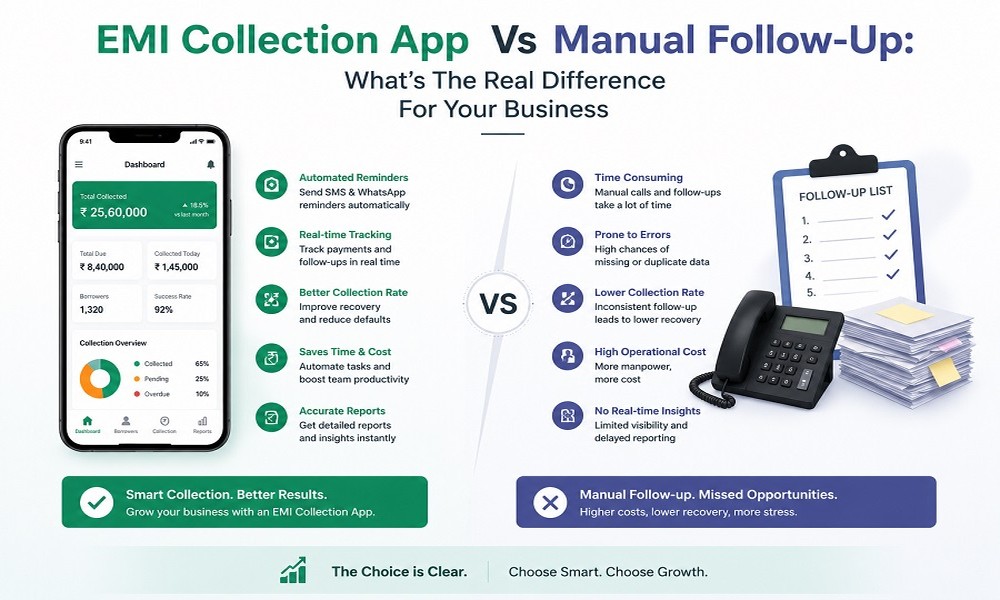
Running a business that offers EMI-based sales in India means you are also running a collections operation. And how well you manage that side has a direct impact on your cash flow, your team’s bandwidth, and your customer relationships. For years, manual follow-up was the only option. Today, the EMI collection app has changed that — and the difference between the two is larger than most business owners expect.
What Manual Follow-Up Actually Looks Like
Manual follow-up sounds straightforward, but in practice it is exhausting. Your team is making calls, sending WhatsApp messages, maintaining Excel sheets, and chasing customers who either do not pick up or promise to pay “by evening” — every day.
The problems compound quickly. There is no centralised record of who was contacted, when, and what was said. Follow-up depends entirely on individual team members, which means when someone is on leave, collections slip. And scaling this process as your business grows means hiring more people — at a higher cost with no guarantee of better results.
In India’s retail and lending ecosystem, where EMI portfolios can run into hundreds of active accounts, manual follow-up simply was not built for this volume.
What an EMI Collection App Brings to the Table
An EMI collection app centralises and automates the entire follow-up process. Instead of relying on a team member to remember who needs a reminder today, the app handles it on its own, sending payment nudges via SMS, WhatsApp, or in-app notifications based on due dates and account status.
But reminders are only half the story. A well-built EMI collection app can remove the need for follow-up entirely on a sizable chunk of your portfolio. This is where UPI Autopay and eNACH come in. At the time of onboarding, the customer authorises an automatic payment mandate. On the due date, the amount is pulled directly from their bank account. No reminder goes out. Nobody picks up the phone. Nothing needs to happen on your team’s side at all. For businesses sitting on a large active EMI book, this is usually where the biggest operational savings come from.
Every interaction is logged. Every payment is tracked in real time. The moment a customer pays, the record updates on its own, with no manual entry and no confusion. For business owners, this means a live view of the entire portfolio at any given moment.
A well-built EMI collection app also segments accounts by risk, which lets your team focus energy where it is actually needed rather than calling everyone with the same urgency.
The Numbers Behind the Difference
The gap between an EMI collection app and manual follow-up becomes very clear when you look at cost and recovery rates. Manual follow-up typically costs ₹35–₹80 per customer contact once you factor in agent time and overhead. An EMI collection app brings that figure down to ₹4–₹12 per contact.
Recovery rates follow the same pattern. Businesses on manual follow-up tend to see early-bucket recovery rates of 55–65%. Those using an EMI collection app consistently report 72–88%. That gap, across hundreds of accounts, is a significant difference in monthly revenue recovered.
Where Manual Follow-Up Still Has a Role
An EMI collection app handles volume efficiently but cannot replace human judgment in every case. High-value defaults, customers facing genuine financial hardship, or accounts that need restructuring — these still benefit from a personal conversation.
The most effective businesses are not replacing their teams entirely. They are using the app for routine follow-up at scale and freeing their people to focus on accounts that genuinely need attention.
Conclusion
The difference between an EMI collection app and manual follow-up is not just operational — it is financial. Lower cost per contact, higher recovery rates, real-time visibility, and the ability to scale without adding headcount make the app the stronger choice for any business managing an active EMI portfolio. Manual follow-up had its time. For businesses serious about collections efficiency in today’s market, adopting an EMI collection app is no longer optional — it is essential.
There is no mention of UPI AutoPay and eNach, which is our core offering of new age emi collection apps, not just a reminder, so I think we should mention that also.
You can rephrase below and use it –
“Beyond reminders, a well-integrated EMI collection app can eliminate the need for follow-up entirely on a significant portion of your portfolio. Through UPI Autopay mandates and eNACH, customers authorise automatic payment deductions at the time of onboarding. On the due date, the amount is pulled directly from their account — no reminder sent, no call made, no action required from your team. For businesses with a large active EMI book, this automated collection layer is often where the biggest operational savings come from.”
