
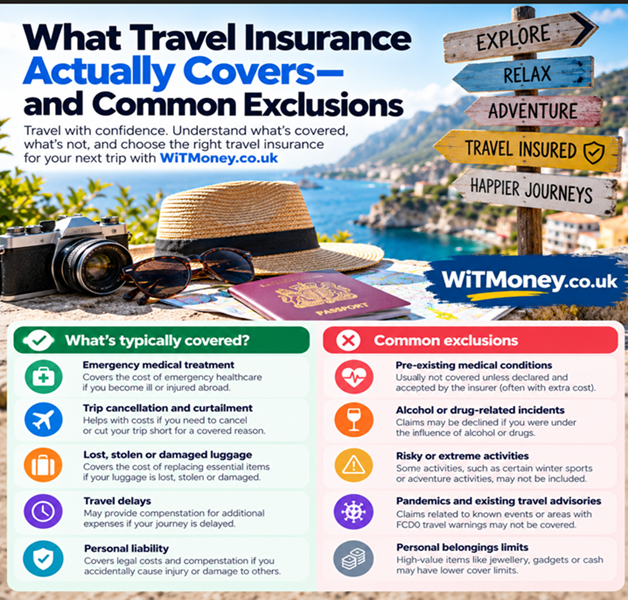
Travel insurance is designed to protect you financially when a trip goes wrong, but not every policy offers the same level of cover.
Some policies focus heavily on medical emergencies. Others provide stronger protection for cancellation, baggage, delays or missed departures. The important thing is to understand both what is covered and what is excluded before you buy.
Travellers comparing policies can use WiT Money’s travel insurance comparison to review different types of cover and the features available.
What Does Travel Insurance Usually Cover?
Most travel insurance policies include a combination of the following areas:
- emergency medical treatment
- cancellation and curtailment
- lost or stolen baggage
- travel delays
- missed departures
- personal liability
- emergency assistance
Optional cover may also be available for winter sports, gadgets, cruises or business travel.
The key point is that each section normally has its own limits, conditions and exclusions.
1. Emergency Medical Expenses
Medical cover is one of the most important parts of travel insurance.
If you become ill or injured abroad, treatment can be expensive, particularly in countries where healthcare costs are high.
A policy may cover:
- hospital treatment
- emergency surgery
- ambulance costs
- doctor consultations
- prescribed medication
- repatriation to the UK if medically necessary
Some policies also pay additional travel or accommodation costs if you cannot return home as originally planned.
However, medical claims may be restricted if a pre-existing condition was not declared.
2. Cancellation Cover
Cancellation cover may reimburse non-refundable travel costs if you have to cancel your trip for a reason listed in the policy.
Possible covered reasons can include:
- serious illness
- injury
- bereavement
- certain family emergencies
- redundancy in some circumstances
- serious damage to your home
What usually does not count is simply changing your mind.
Likewise, deciding not to travel because you feel uncomfortable about a destination may not be covered unless the policy specifically includes that situation.
3. Curtailment Cover
Curtailment applies when you have already started your trip but need to return home early.
For example, you may need to end your holiday because:
- you become seriously ill
- a close relative has a medical emergency
- your home is badly damaged
Depending on the policy, you may be able to claim for unused accommodation or travel costs.
4. Lost, Stolen or Damaged Baggage
Many travel insurance policies include baggage cover.
This can help with the cost of replacing:
- clothing
- luggage
- personal belongings
- travel documents
However, baggage claims often include a single-item limit.
So even if your overall baggage cover is £2,000, an expensive laptop or watch may only be covered up to a much lower amount.
Check:
- overall baggage limit
- single-item limit
- valuables limit
- excess
before relying on the policy.
5. Lost or Stolen Passports
Some travel insurance policies also cover passport-related costs.
This may include:
- emergency travel documents
- transport to an embassy or consulate
- replacement-related expenses
- extra accommodation in some circumstances
You may need to report the loss to the police or local authorities before making a claim.
6. Travel Delay Cover
Travel delay cover may pay compensation if your departure is delayed beyond a minimum period.
For example, a policy may start paying after:
- 6 hours
- 12 hours
- 24 hours
The exact threshold varies.
Some policies provide a fixed payment, while others reimburse reasonable additional costs.
Travel delay cover is separate from any compensation rights you may have from an airline.
7. Missed Departure
Missed departure cover may help if you miss your flight or ferry because of circumstances outside your control.
Examples could include:
- major public transport disruption
- vehicle breakdown
- serious road accident
Simply leaving home too late is unlikely to be covered.
The insurer may ask for evidence of what caused the delay.
8. Personal Liability
Personal liability cover can protect you if you accidentally injure someone or damage their property.
This may include certain legal costs or compensation claims.
However, exclusions often apply where the incident involves:
- motor vehicles
- business activity
- deliberate acts
- hazardous sports
9. Personal Accident Cover
Some policies include a fixed benefit if an accident causes a serious injury, permanent disability or death.
This is separate from emergency medical cover.
The benefit amount depends on the policy wording and the type of injury.
10. Emergency Assistance
Many insurers offer a 24-hour emergency assistance line.
This can help arrange:
- medical treatment
- hospital communication
- emergency transport
- repatriation
- travel changes after a serious incident
For major medical claims, the insurer may require you to contact them as soon as reasonably possible.
Common Travel Insurance Exclusions
Understanding exclusions is just as important as understanding the cover itself.
A claim may fall under a broad section such as “medical expenses” or “cancellation” but still be excluded because of the circumstances.
Pre-Existing Medical Conditions
Pre-existing medical conditions are one of the most important areas to check.
Insurers may ask about:
- diagnosed conditions
- ongoing treatment
- prescription medication
- recent hospital visits
- medical investigations
If you fail to declare a condition when required, a related claim could be rejected.
Some insurers provide cover after medical screening, sometimes for an additional premium.
Travelling Against Medical Advice
Policies commonly exclude claims where a traveller goes abroad against the advice of a doctor or other medical professional.
Travel for the main purpose of receiving medical treatment may also be excluded.
Alcohol and Drug-Related Incidents
Travel insurers may decline claims where alcohol or drugs materially contributed to the incident.
This does not necessarily mean any alcohol consumption invalidates the policy.
The exact wording matters.
High-Risk Sports and Activities
Standard policies may not automatically cover:
- skiing
- snowboarding
- scuba diving
- mountaineering
- skydiving
- certain water sports
- competitive sports
Some insurers allow you to add specialist activity cover.
If your holiday includes adventurous activities, check the policy before travelling.
Unattended Belongings
Insurers may reject baggage claims where possessions were left unattended or unsecured.
For example:
- valuables left on a beach
- a phone left in an unlocked vehicle
- luggage left unattended in a public place
Many policies also require theft to be reported to local police.
Valuables Above Policy Limits
A policy may have a generous overall baggage limit but a much lower single-item cap.
This is especially important for:
- laptops
- cameras
- jewellery
- watches
- smartphones
If you are travelling with expensive items, check whether specialist cover is needed.
Known Events
Travel insurance generally protects against unforeseen events.
If you buy a policy after a problem is already known, related claims may not be covered.
For example, if a major disruption has already been publicly announced before you buy the policy, the insurer may treat it as a known event.
Government Travel Warnings
Policies may exclude travel to destinations where official government advice warns against travel.
Before travelling, check the latest Foreign, Commonwealth & Development Office guidance.
The exact impact depends on the policy wording.
Illegal or Reckless Behaviour
Claims connected to criminal activity or deliberate reckless behaviour may be excluded.
Travel insurance is not designed to protect against every consequence of unlawful conduct.
Natural Disasters
Cover for:
- earthquakes
- floods
- hurricanes
- wildfires
- volcanic eruptions
varies by insurer.
Some policies include protection under cancellation or delay sections, while others require specific additional cover.
Airline or Supplier Failure
Not all policies cover the financial failure of:
- airlines
- tour operators
- hotels
- travel providers
Some policies offer scheduled airline failure or end-supplier failure cover, but this is not always standard.
Business Travel
A leisure policy may not automatically cover business activity.
If you are travelling for:
- meetings
- conferences
- manual work
- consultancy
- professional services
check whether business travel is included.
Single-Trip vs Annual Travel Insurance
There are two main types of travel insurance.
Single-Trip Cover
Designed for one specific trip.
This may suit people who travel only occasionally.
Annual Multi-Trip Cover
Designed for multiple trips during a 12-month period.
This can be more convenient for frequent travellers.
However, annual policies usually limit the maximum duration of each individual trip.
Always check the maximum trip length.
European vs Worldwide Travel Insurance
Travel insurance is often divided into geographical zones.
Typical options include:
- Europe
- worldwide excluding certain countries
- worldwide including the USA and Canada
Worldwide cover that includes countries with high healthcare costs may be more expensive.
Make sure every destination on your itinerary is included in the policy area.
How Much Cover Do You Need?
The right amount of cover depends on the type of trip.
Consider:
- destination
- trip cost
- value of luggage
- health needs
- activities planned
- trip duration
A weekend break in Europe may require different cover from a long-haul family holiday or extended backpacking trip.
What Should You Compare Before Buying Travel Insurance?
- medical expense limit
- cancellation cover
- curtailment cover
- baggage limit
- single-item limits
- valuables cover
- excess
- travel delay benefits
- missed departure cover
- personal liability
- activity restrictions
- medical screening rules
- destination restrictions
- maximum trip duration
- emergency assistance
The best policy is not necessarily the cheapest one.
It is the policy that provides appropriate cover for your trip at a reasonable cost.
Why the Excess Matters
The excess is the amount you may need to pay towards a claim.
For example, if you make a £500 claim and the policy has a £100 excess, the insurer may pay £400.
Check whether the excess applies:
- per claim
- per person
- per section
A low-cost policy with a high excess may offer less practical value than it first appears.
Is Cheap Travel Insurance Worth It?
Cheap travel insurance can be suitable in some cases, but price should not be the only factor.
A very low-cost policy may offer:
- lower medical limits
- higher excesses
- more exclusions
- lower baggage limits
- fewer cancellation reasons
At the same time, paying more does not automatically guarantee better cover.
The objective is to compare what you actually get for the premium.
Final Thoughts
Travel insurance can provide important financial protection when something goes wrong before or during a trip.
But the value of a policy depends on the details.
Two policies may both advertise medical, baggage and cancellation cover while providing very different limits, exclusions and excesses.
Before buying, read the policy terms carefully and think about the risks most relevant to your trip.
You can compare travel insurance options and guides with WiT Money to review different types of travel cover and understand how policies may differ.
Knowing what travel insurance covers – and what it excludes – can help you choose a policy with fewer surprises if you ever need to make a claim.
