Author

admin

Browsing

The second week of March 2026 changed the rules. A geopolitical crisis in the Middle East, oil prices not seen since the 1970s, and a Federal Reserve caught between inflation and recession converged into the most volatile market stretch in years. For anyone with capital at risk, the question is no longer whether you need real-time market intelligence. The question is where you get it.

Why Daily Coverage Beats Weekly Summaries

Between March 9 and April 10, the S&P 500 swung more than 2% in a single day over a dozen times. Oil moved 10% in one session twice. The VIX spiked above 30 and collapsed below 20 within a single week. In this environment, a Saturday recap is an obituary. The trades have already been made.

The investors who navigated this stretch had access to structured, data-driven briefings that explained what was happening, why it mattered, and what came next. At AlphaEdge, every trading day produces a morning update before the bell covering futures, global markets, and a specific S&P 500 range prediction, followed by an end-of-day wrap with closing scoreboards, all eleven sector ETFs, mega-cap movers, fixed income, commodities, and an editorial called “The AlphaEdge Take.” Weekend weekly wrap-ups tie the full five-day narrative together with detailed tables, economic data roundups, and geopolitical context.

A Real Example: March 17-21

Monday and Tuesday delivered a 1.7% rally as Bessent confirmed Iranian oil tankers were transiting Hormuz and Nvidia unveiled a trillion-dollar order backlog. By Wednesday, a scorching PPI report at 0.7% month-over-month, a hawkish Fed hold, and Iranian strikes on Gulf infrastructure sent Brent past $107. The S&P 500 fell 2.2% for the week. SMCI crashed 33%. Rate-cut odds collapsed from 95% to below 15%. AlphaEdge’s detailed weekly wrap-up for March 17-21 tracked the narrative from Monday’s optimism through Friday’s capitulation, connecting every data point to a coherent forward-looking thesis.

The Bottom Line

Markets now move 3% on a single headline. Informed investors cannot afford to catch up later. They need analysis before the open, after the close, and across the full weekly arc. AlphaEdge delivers exactly that, every trading day, with no paywalls and no fluff.

https://alphaedgehub.com/

https://alphaedgehub.com/articles/sp500-four-week-losing-streak-fed-holds-rates-oil-surges-brent-108-smci-crashes-ppi-hot-iran-war-march-17-21-2026.html

I look at stock analysis tools through a simple lens. If a platform helps you move from raw data to a clear decision, it has value. If it slows you down or hides insight behind complexity, it works against you. One example worth studying is stock analysis tools, which shows how a modern platform can bring clarity to a process that often feels scattered.

I focus on tools that make analysis easier to follow, not harder to understand. You are here to make better decisions, not to get buried in numbers. The right setup should help you filter opportunities, compare companies, and understand value without friction. That is what I will break down.

Why stock analysis tools matter

If you rely on guesswork, you will always second guess your decisions. Strong investing comes from structure.

A solid stock analysis platform helps you:

  • Find new opportunities using filters instead of random searching
  • Compare companies using consistent metrics
  • Understand valuation instead of relying on price alone
  • Track performance and adjust your thinking over time

Without tools, you are reacting. With tools, you are deciding.

What to look for in a stock analysis platform

I suggest keeping your standards simple. A good platform should cover a few core areas well.

Stock screener

A stock screener is your starting point. It helps you narrow thousands of stocks into a short list that fits your criteria.

Look for filters like:

  • Market cap
  • Price to earnings ratio
  • Revenue growth
  • Profit margins

The best stock screener lets you adjust filters quickly and see results in real time.

Financial data and ratios

Numbers matter, but only if they are organized clearly.

You should be able to review:

  • Earnings per share
  • Return on equity
  • Debt levels
  • Cash flow

Clean presentation makes a difference. If you cannot scan data fast, the tool slows you down.

Valuation tools

Price does not equal value. A strong investment research platform should help you estimate whether a stock is under or overvalued.

This includes:

  • Intrinsic value estimates
  • Price to earnings comparisons
  • Growth expectations

These tools help you avoid overpaying and spot opportunities others miss.

Comparison tools

You should never analyze a company in isolation. Side by side comparison shows you what stands out.

A strong comparison tool helps you:

  • Compare financial performance
  • Evaluate valuation differences
  • Identify stronger business models

This step sharpens your judgment.

How Tickerplace approaches stock analysis

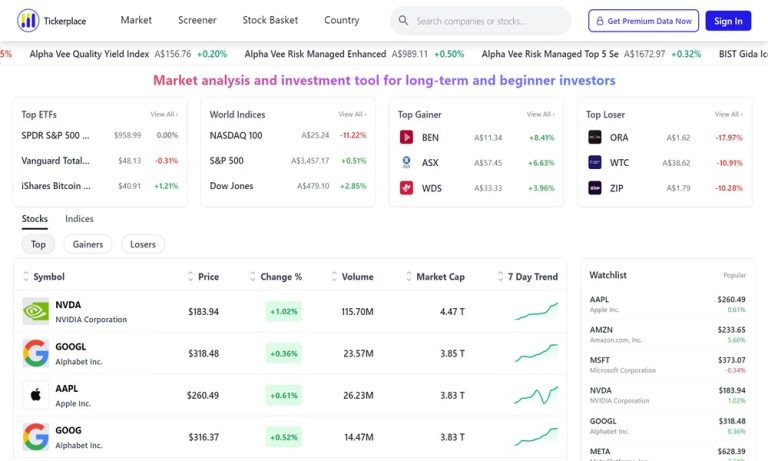
Tickerplace stands out because they focus on clarity. Many stock research tools either overwhelm beginners or limit serious investors. They aim to solve both problems.

Their platform combines several tools into one place:

  • A stock screener for filtering opportunities
  • Structured financial data for quick review
  • Valuation models to assess pricing
  • Comparison tools for side by side analysis
  • Portfolio tracking for ongoing management

This matters because it removes the need to jump between multiple platforms. You stay focused on analysis instead of searching for data.

Another advantage is how they present information. Financial data is organized in a way that makes sense. You can move from screening to deeper analysis without changing tools or losing context.

Why this matters for beginners

If you are new to investing, complexity is the biggest barrier. Many platforms assume you already understand everything.

A better approach is gradual learning.

Tickerplace supports this by:

  • Simplifying financial data without removing depth
  • Providing guided insights on key metrics
  • Keeping the interface clean and easy to navigate

You can start with basic filters, then move into deeper analysis as your understanding improves.

Why this matters for experienced investors

If you already analyze stocks, your focus shifts to efficiency.

You want:

  • Faster filtering
  • Cleaner comparisons
  • Reliable valuation data

Tickerplace helps by organizing everything in one place. This reduces time spent switching tools and increases time spent making decisions.

It also supports deeper analysis through access to financial ratios and historical data, which are critical for long term investing.

How to actually analyze stocks using these tools

I keep the process simple and repeatable. You can follow this structure:

Step 1: Screen for opportunities

Use an online stock screener to filter based on your criteria. Focus on a small list of candidates.

Step 2: Review fundamentals

Look at revenue, earnings, and profitability. Avoid companies with weak fundamentals unless you understand the risk.

Step 3: Check valuation

Compare the current price to estimated value. Ask if the stock is fairly priced.

Step 4: Compare alternatives

Place similar companies side by side. This helps you see which one stands out.

Step 5: Make a decision

Once the data is clear, act based on your criteria. Avoid overthinking once the work is done.

Final perspective

Stock market tools for beginners and experienced investors should serve one purpose. They should help you think clearly.

Tickerplace is a strong option because they bring together stock analysis software, research tools, and valuation insights in a way that stays practical. The platform removes friction, organizes data, and keeps your focus on decision making.

If you choose your tools carefully and follow a consistent process, you put yourself in a position to make better investment decisions over time.

In today’s ever-evolving financial landscape, making informed and strategic financial decisions is crucial at every stage of life. Whether you are planning for retirement or safeguarding your future against unforeseen health issues, Abich Financial Services provides expert guidance tailored to meet individual needs. With a focus on financial education and personalized strategies, Abich Financial has distinguished itself as a leader in financial planning. This article explores the comprehensive services they offer and how they can serve as a valuable partner in achieving financial peace of mind.

Understanding Abich Financial Services

Located in Ashburn, Virginia, Abich Financial Services is dedicated to helping clients make wise financial decisions. Founded by Abe Abich, the company has built a reputation for its expertise in retirement planning, wealth management, and handling the intricacies of Medicare. The firm’s mission is to empower clients with the knowledge and tools needed for long-term financial stability. By providing personalized guidance, Abich Financial tailors recommendations to each client’s goals and priorities.

Retirement Planning: Securing Your Golden Years

One of the key areas where Abich Financial excels is in retirement planning. Their team understands that a secure retirement requires more than just savings; it involves strategic investment and risk management. Abich Financial offers tailored solutions to help clients transition smoothly into retirement. They assist with developing a comprehensive plan that includes income strategies, asset distribution, and tax-efficient savings methods. This holistic approach helps retirees enjoy their golden years with greater peace of mind and less financial worry. Those interested in learning more can explore their services on Abich Financial’s retirement planning page.

Wealth Management: Growing and Protecting Assets

Effective wealth management is key to maintaining and growing one’s financial resources. Abich Financial’s wealth management services are designed to protect and enhance their clients’ portfolios through a range of investment strategies tailored to suit individual risk appetites and financial goals. Working closely with clients, their team provides comprehensive analyses and develops investment strategies that align with both short-term objectives and long-term aspirations. By continuously monitoring market trends and making timely adjustments, they work to support strong portfolio performance.

Holistic Approach to Financial Education

Abich Financial strongly believes in the power of education in making informed financial decisions. The firm regularly conducts seminars and workshops aiming to educate the community about various financial topics such as retirement planning, retirement tax, and estate planning. These educational initiatives are part of their commitment to empowering clients and the community at large with the information needed to make sound financial choices.

Community Involvement: A Commitment to Serving Others

In addition to providing exceptional financial services, Abich Financial has a firm commitment to community involvement. By actively participating in local events and supporting charitable endeavors, the firm demonstrates its dedication to giving back to the community. This involvement reflects their core values of integrity and service, providing clients with the assurance that they are partnering with a company that cares about more than just the bottom line.

For more information, visit the official Abich Financial website to discover how their services can help secure your financial future. With their expertise and client-centered approach, Abich Financial is well-equipped to guide individuals through life’s various stages while supporting long-term financial stability and prosperity.

The success of any new business depends on its people. But finding the right talent remains a huge challenge for founders. Now you must decide how to build your core team. Sometimes you lack the time to screen every single candidate. So the search for elite professionals becomes a heavy burden. This is where experts like Carpathian Global Talent Co enter the picture. They bridge the gap between your vision and the global workforce.

Finding Quality Talent Fast

Building a team is a race against time for most startups. But quality cannot be sacrificed for speed during this critical phase. Now you can leverage external expertise to accelerate your hiring cycles. The best partners understand the unique pressure of early stage growth. They provide access to pre-vetted experts from diverse talent pools. You need people who hit the ground running from day one. Carpathian Global Talent Co specializes in finding these high impact individuals quickly. They help you avoid the common trap of hiring the wrong person.

Reducing Your Operational Costs

Startups often operate on very tight budgets and limited resources. So spending thousands on failed recruitment efforts is a major risk. Now you should consider the efficiency of a specialized agency. They reduce the cost of advertising and lengthy internal screening processes. Best Recruitment Agencies for Startups offer flexible models that fit your financial reality. This allows you to scale up or down based on your needs. You get the benefit of a full recruitment department without the overhead. This strategic move keeps your burn rate low while you grow.

Accessing Global Talent Pools

The local market might not always have the specific skills you need. But the world is full of brilliant professionals ready to work. Now the remote work revolution has opened doors for every ambitious founder. Sometimes the best engineer or marketer lives in a different time zone. You can find incredible value by looking toward international talent hubs. Carpathian Global Talent Co connects you with experts in regions like Eastern Europe. This gives you a competitive edge in a crowded tech landscape. Global hiring allows you to build a diverse and resilient workforce.

Ensuring a Strong Cultural Fit

A small team needs a shared mission to survive the struggle. But technical skills alone do not guarantee a successful working relationship. Now you must vet candidates for their values and their work ethic. Recruitment agencies act as a filter to ensure a perfect match. They understand the fast paced nature of the startup environment. You get to meet people who truly believe in your product. This alignment is vital for long term retention and team morale. A cohesive culture becomes the foundation for your future corporate success.

One of the biggest retirement myths is just saving enough money.

It’s not.

The real hard work starts when you retire. It’s not a matter of accumulating wealth. Remember its evolution from wealth to scale, and then scale to speed − It is about converting that wealth to steady income – without drying it out.

This is where the line gets kind of grey.

How to Adjust to a Change Nobody Warns You About?

Paychecks come through the door when you are working. Every month your account gets credited with a paycheck. Bills get paid. Savings grow.

Retirement flips that system.

Now money flows out.

You are the paycheck.

That shift sounds simple. But it changes everything.

Withdrawal timing or allocation must be perfect − even one wrong decision can reduce income for decades. The markets do not give a shit that you are no longer working! Well, they will keep moving up and down − anyway.

It is More Than Just “The 4% Rule”

You’ve probably heard the rule. Withdraw 4% per year. Adjust for inflation. You’ll be fine.

Reality is less tidy.

Life doesn’t move in averages.

  • Some years bring market losses.
  • Some years bring medical bills.
  • Family support needs are there some years.

These dynamic lives do not subscribe to rigid formulas.

Income planning requires flexibility. It is about managing withdrawals relative to performance and living costs, not trusting a mathematic constant.

Inflation is Quiet but Relentless

Here’s the part many overlooks.

Even mild inflation will erode purchasing power in half in 20 years.

Healthcare expenses are usually increasing more highly than inflation. Housing costs shift. Insurance premiums increase.

If there is no growth in income, the lifestyle shrinks.

Your retirement income plan should be a smart one − and smart is all about the details, which include:

  • Assets that hedge inflation
  • Withdrawal sequence that shelter growth assets
  • Sustainability for the long-run once the early retirement years pass

Growth still matters. Even after 65.

Taxes are the Silent Threat

One thing that doesn’t get enough love in the retirement world is taxes.

But the focus is where you back out of.

Each type of account comes with its own set of tax implications, after all. Harvesting income from the wrong source at the wrong time can bump you up into higher brackets, or higher Medicare premiums.

Thoughtful, strategic withdrawals can make money go a long way!

This is why professional retirement planning services can really help. The best strategy is to limit leakage while maintaining flexibility through time.

Longevity Changes the Equation

It’s not just that retirement lasts longer than it used to.

That means we spend 25-30 years not receiving a paycheck. That spans almost a second career.

One of the biggest fears people have is running out of money in retirement, which is why you need to plan for longevity risk − the risk of living long after your money does.

It requires a mix of:

  • Stable income sources
  • Growth potential
  • Conservative cash buffers

Balance becomes essential.

The Clearer Way Forward

There is no magic rule that can take care of all of your retirement income planning. It isn’t about chasing yield. And it isn’t about guessing.

It’s about designing a system.

A system that adapts. A system that protects. A system that is there for you through the market cycles and surprises of life.

And once you see the income problem in all its clarity, retirement ceases to be a lottery.

It becomes a plan.

When a wildfire causes a total loss of your home and property, the immediate aftermath can feel overwhelming. Before you can even begin to think about rebuilding or updating legal documents, a thorough assessment of what remains, and what has been lost, is necessary. This process is not just about physical possessions; it’s about understanding the full scope of your estate in its altered state.

Creating a Detailed Asset Inventory

One of the very first steps after a disaster is to create a comprehensive list of everything you owned. This isn’t just a casual mental note; it needs to be detailed. Think about:

  • Real Estate: The primary dwelling, any outbuildings, and the land itself.
  • Personal Property: This includes everything from furniture, electronics, and clothing to artwork, jewelry, and collections.
  • Vehicles: Cars, trucks, motorcycles, boats, and any other motorized items.
  • Financial Assets: While these might be less physically impacted, knowing account numbers and types is important.
  • Important Documents: Birth certificates, passports, deeds, and other vital records.

This detailed inventory serves as a foundational record of your estate’s value before any insurance claims or disaster relief applications can be properly processed. If original records were destroyed, this list becomes even more critical for proving ownership and value.

Understanding Insurance Policy Coverage

Your insurance policy is your primary resource for financial recovery. It’s important to understand what your policy actually covers. Look at the declarations page first, which summarizes your coverage limits. Then, review the full policy to grasp the specifics. Key areas to focus on include:

  • Dwelling Coverage: This typically covers the structure of your home. Understand if it’s based on replacement cost or actual cash value.
  • Personal Property Coverage: This covers your belongings inside the home.
  • Loss of Use/Additional Living Expenses (ALE): This covers costs incurred if you can no longer live in your home, such as hotel stays, meals, and other temporary living expenses.
  • Other Structures: Coverage for detached garages, sheds, or fences.

Knowing these details upfront will help you manage expectations and prepare for discussions with your insurance adjuster.

Documenting Losses for Claims and Relief

Thorough documentation is key to a successful insurance claim and applications for disaster relief. Take photos and videos of the damage, even if it seems like everything is gone. If possible, try to salvage any damaged items that might still have some value or can be used as evidence of loss. Keep meticulous records of all expenses related to the disaster, including temporary housing, meals, and any costs associated with securing your property. This detailed record-keeping will be invaluable when you are filing claims with your insurance company and applying for assistance from government agencies like FEMA or other relief organizations.

Updating Estate Planning Documents

After a significant loss, like a wildfire, it’s not just about rebuilding structures; it’s also about rebuilding your estate plan. Documents that were once thought to be complete may now need adjustments to reflect your current situation and wishes. Failing to update these documents can lead to unintended consequences and complications for your loved ones.

Reviewing and Revising Your Will

Your will is a foundational document that outlines how your assets should be distributed after your passing. If your circumstances have changed due to a disaster, such as acquiring new assets or losing existing ones, or if your beneficiaries’ needs have shifted, your will needs a review. For instance, if a primary beneficiary has also suffered a loss and requires more immediate financial support, you might consider adding clauses for emergency distributions. It’s also important to ensure that your will is accessible. If the original document was destroyed, you will need to create a new one. Without a valid will, your estate could be subject to state intestacy laws, meaning the court decides how your property is divided, which might not align with your personal desires. This process can also be lengthy and costly for your heirs.

Modifying Trust Provisions

Trusts offer a flexible way to manage and distribute assets, and like wills, they may require updates post-disaster. If valuable assets were placed in a trust, it’s important to confirm that the trust’s terms still accurately reflect your intentions. For example, if the property owned by the trust has been destroyed, you’ll need to address how any insurance payouts are managed and potentially reinvested according to the trust’s guidelines. A well-structured trust can help protect assets from creditors and can streamline the transfer of property, avoiding the lengthy probate process that can occur with a will alone. It’s also a good idea to review who is named as the trustee and successor trustee, especially if your original choices are no longer able to serve. Having a successor trustee readily available is a key benefit of trusts, particularly during times of crisis [0823].

Ensuring Access to Critical Documents

In the chaos following a disaster, having easy access to your important papers is paramount. This includes not only your will and trust documents but also powers of attorney, health directives, and insurance policies. Consider creating a digital backup of these documents, stored securely in the cloud, and also keeping physical copies in a fireproof, portable safe or with a trusted individual who lives outside the affected area. This

Protecting Assets Through Trusts

Placing Valuable Assets in a Trust

Many individuals choose to place significant assets, such as their primary residence, into a trust as part of their estate planning. This strategy offers several advantages over a simple will. For instance, a trust can help avoid the probate process, which is a court-supervised procedure that can be lengthy, public, and costly. When property is held in a trust, it can pass directly to beneficiaries without going through probate, saving your heirs time, money, and potential conflict. Furthermore, trusts can provide for disability planning. Should you become incapacitated, a successor trustee can step in to manage your assets without the need for a court-appointed guardianship, a process that can be stressful and expensive for your family.

Understanding Trust Benefits Post-Disaster

Beyond avoiding probate and planning for incapacity, trusts can offer a layer of protection for your beneficiaries’ inheritance. A standard revocable living trust, upon your passing, typically distributes assets directly to your heirs. However, once distributed, these assets may become vulnerable to issues like divorce, lawsuits, or creditor claims. To provide lasting protection, estate plans often incorporate specialized sub-trusts, sometimes called inheritance protection trusts. These structures can hold inherited assets for beneficiaries, shielding them from external risks while still allowing the beneficiaries to benefit. This means that even if a beneficiary faces financial difficulties or a marital dissolution, the inherited wealth can remain secure for future generations. This level of protection is a key reason why many families consider trusts for their most important assets.

Addressing Insurance for Trust-Owned Property

A critical, yet often overlooked, aspect of placing property into a trust involves insurance coverage. When a home’s deed is transferred to a trust, the legal ownership changes. The trust, not the individual, becomes the legal owner. Insurance policies are written to cover specific named individuals or entities. If the name on the insurance policy does not match the legal owner listed on the deed, a coverage issue can arise. This mismatch has led to claim disputes and even denials after disasters, including wildfires. For example, a family might have a $500,000 home in a trust, but if their homeowners insurance policy still lists their individual name, an insurer could deny a claim for total loss. To prevent this, it is vital to:

  • Contact your insurance agent immediately to inform them that your property is held in a trust.
  • Request that the trust be added to the policy, either as the named insured or an additional insured.
  • Obtain written confirmation from the insurance company that the trust is properly listed and covered.

This simple update is a crucial step in protecting your largest asset and ensuring your estate plan functions as intended, especially after a significant loss.

Navigating Insurance Claims and Settlements

Dealing with insurance claims after a total loss can feel like a whole other disaster. It’s a process that requires careful attention to detail and a clear understanding of your policy. The goal is to get the compensation you’re entitled to so you can begin rebuilding.

Understanding Replacement Cost vs. Actual Cash Value

Your insurance policy likely specifies how it will value your lost property. There are generally two main ways this is calculated:

  • Actual Cash Value (ACV): This method pays you for the depreciated value of your property. Think of it as what the item was worth right before it was destroyed, considering its age and wear.
  • Replacement Cost Value (RCV): This method pays you the amount it would cost to replace your lost property with a new item of similar kind and quality, without deducting for depreciation. This is usually the more favorable option for rebuilding.

It’s important to know which method your policy uses, as it can significantly impact the amount you receive. If your policy covers replacement cost, you’ll need to gather estimates for rebuilding or replacing items at today’s prices.

Negotiating Your Wildfire Claim Settlement Amount

Once you’ve submitted your claim, the insurance company will likely send an adjuster to assess the damage. This is where negotiation often comes into play. You’ll want to be prepared with your own documentation, including:

  • A detailed inventory of lost items, with photos or receipts if possible.
  • Contractor estimates for rebuilding costs.
  • Any other evidence supporting the extent of your losses.

If the claim is complex, or if you feel the settlement offer is too low, consider hiring a public adjuster. These professionals work for you, not the insurance company, and can help present your claim effectively. They typically charge a percentage of the settlement amount. Lawyers are usually only needed if there are disputes about coverage limits themselves.

Managing Multiple Insurance Payouts

After a total loss, you might receive several types of payments from your insurance company. It’s common to get payments for:

  • Dwelling coverage: To rebuild or repair your home.
  • Personal property: To replace lost belongings.
  • Loss of use (Additional Living Expenses – ALE): To cover costs like temporary housing, food, and other necessities while your home is uninhabitable.

Be aware that some payments, especially those for rebuilding, may require the signature of your mortgage company. It’s wise to discuss with your mortgage lender how these funds will be managed, perhaps through an escrow account, to ensure they are used for rebuilding and to pay contractors as work progresses. Never sign a global release until all aspects of your claim have been fully resolved and paid.

Emergency Provisions and Distributions

When a natural disaster like a wildfire strikes and causes total loss, the immediate aftermath can be chaotic. Your estate plan needs to account for this disruption. This section focuses on how to build flexibility into your will and trusts to help beneficiaries during such a crisis.

Incorporating Immediate Distribution Clauses

Standard estate plans often involve a waiting period before assets are distributed. However, in the face of a disaster, beneficiaries may need funds urgently for immediate needs. Consider adding clauses that allow for expedited or emergency distributions of certain assets or funds to beneficiaries who have been directly impacted by a disaster. This could include funds for temporary housing, essential supplies, or medical care. These provisions should clearly define the conditions under which such distributions can be made and who has the authority to approve them, such as the executor or a designated trustee. This proactive step can provide much-needed financial relief when it’s needed most.

Planning for Beneficiary Displacement

Wildfires can force people to evacuate their homes, sometimes with little notice and few possessions. Your estate plan should anticipate this possibility. Think about how beneficiaries might be affected if they are displaced. This could involve:

  • Ensuring that copies of important documents, including the estate plan itself, are stored in a secure, off-site location or digitally accessible. This way, if physical copies are lost or inaccessible, the plan can still be referenced. You can find resources for replacing lost documents through organizations like FEMA.
  • Specifying how funds can be used to assist with temporary relocation, such as covering hotel stays or rental costs.
  • Designating a trusted individual who can act on behalf of a beneficiary if they are unreachable or incapacitated due to the disaster.

Accessing Health Directives in Emergencies

Beyond financial matters, a disaster can also create urgent medical situations. It is important that your health directives, such as a living will or durable power of attorney for healthcare, are readily accessible to medical professionals and your designated healthcare agents. If these documents are lost or destroyed, emergency responders may not know your wishes regarding medical treatment. Storing copies with your attorney, with trusted family members, or on a secure cloud service can help ensure they are available when needed. This allows your healthcare agents to make informed decisions consistent with your preferences, even if you are unable to communicate them yourself. Having these documents in order is a vital part of estate planning for unforeseen events.

Rebuilding and Long-Term Recovery Planning

The path to recovery after a total loss from a wildfire is a marathon, not a sprint. It involves more than just rebuilding structures; it’s about reconstructing lives and futures. This phase requires careful planning and a clear understanding of the steps involved.

Securing Temporary Housing and Essentials

Following a wildfire, immediate needs like shelter and basic necessities become paramount. Survivors often face the challenge of finding suitable temporary housing while their permanent homes are unusable or being rebuilt. This can involve utilizing insurance payouts for additional living expenses (ALE) to cover hotels, rental properties, or even staying with friends and family. Beyond shelter, securing essential personal belongings that may have been lost is also a priority. Disaster resource centers can be incredibly helpful during this time, offering assistance with everything from utility cancellations to replacing vital documents. The goal is to establish a stable base from which to begin the longer-term recovery process.

Working with Disaster Recovery Centers

Disaster recovery centers are established to provide a centralized point of contact for survivors. These centers offer a wide array of support services, connecting individuals with resources that can help them navigate the complex aftermath of a wildfire. Services can range from financial assistance and legal aid to mental health support and guidance on rebuilding permits. It is advisable to visit these centers early in the recovery process to understand the full scope of available aid and how to access it. They can also assist with reevaluating property taxes and provide information on nonprofit aid organizations.

Considering Charitable Giving for Relief Efforts

While focusing on personal recovery, many individuals also feel a desire to contribute to the broader relief efforts. Incorporating charitable giving into one’s estate plan, or making direct donations, can be a way to support communities affected by wildfires. This can range from supporting local relief organizations to contributing to national disaster relief funds. For those who have experienced a total loss, the process of rebuilding can be lengthy, and understanding the timeline for insurance claims and settlements is a key part of managing expectations and planning for the future. The journey from loss to rebuilding is often a difficult one, and survivors may find that their recovery takes longer than initially anticipated, as seen in the ongoing challenges faced by survivors one year after a major fire.

Explore Further

In an increasingly fast-paced and competitive environment, businesses must constantly evaluate how they operate to stay ahead. Whether it’s streamlining workflows, managing overheads, or improving customer service, operational efficiency has become more important than ever. For many businesses, outsourcing has emerged as a powerful strategy to meet these demands without compromising quality or growth.

From administrative support to customer contact services, outsourcing non-core functions can help organisations focus on what they do best—while allowing trusted partners to manage the rest.

Why Consider Outsourcing?

At its core, outsourcing is about improving efficiency. Rather than stretching internal resources thin or hiring full-time staff for functions that don’t directly impact your bottom line, outsourcing allows businesses to delegate these tasks to experienced providers. This means you gain access to specialists who can complete the work faster, more accurately, and often at a lower cost.

A common route for companies looking to enhance efficiency is through Business Process Outsourcing—a model where specific processes, such as data entry, call handling, or document processing, are managed externally by a dedicated team. This approach helps ensure consistency, compliance, and scalability, while freeing your internal staff to focus on strategic tasks.

Benefits Beyond Cost Saving

While reducing overheads is one of the most talked-about advantages of outsourcing, the benefits go far beyond finances. Outsourcing offers:

Improved Productivity: 

Delegating routine or time-consuming tasks lets your in-house team concentrate on more impactful, value-driven activities.

Scalability: 

As your business grows, outsourcing allows you to expand your operations without the delays or costs associated with recruitment and training.

Access to Expertise: 

Outsourcing partners bring industry knowledge, advanced tools, and well-established processes to the table.

Risk Reduction: 

Professional service providers are typically well-versed in compliance, data security, and quality standards, reducing your exposure to operational risks.

In short, outsourcing isn’t just about doing things cheaper—it’s about doing them better.

Flexible Support When You Need It

Another compelling aspect of outsourcing is flexibility. Whether you need support during a peak season, help launching a new project, or long-term management of back-office operations, outsourcing allows you to scale services up or down as needed. This agility can be especially useful for SMEs that require reliable support without committing to full-time hires.

Additionally, having access to a ready-made team can speed up timelines and reduce the stress of operational bottlenecks, enabling businesses to stay on track even during times of rapid change.

Choosing the Right Outsourcing Provider

If you’re thinking about outsourcing, choosing the right partner is key. A good outsourcing provider should act as an extension of your team, understanding your goals and integrating seamlessly into your processes. Look for transparency, clear communication, and a strong track record of delivering measurable results.

Before committing, it’s also important to define the scope of work, establish KPIs, and ensure data protection protocols are in place. The right provider won’t just complete tasks—they’ll contribute to the long-term success of your business.

Final Thoughts

Outsourcing is no longer a luxury reserved for large enterprises. It’s a practical, strategic solution that empowers businesses of all sizes to operate more efficiently, stay competitive, and prepare for future growth.

By outsourcing the right tasks to the right people, you can unlock valuable time, reduce pressure on your internal teams, and maintain the high standards your customers expect. Whether it’s administrative support or full-scale process management, outsourcing can help you work smarter—not harder.

Financing is one of the major concerns for those who want to invest in real estate projects. Even homeowners look for quick cash to repair their houses. For instance, a full-house remodeling project is a costly affair for most property owners. That is why many people turn to private lenders for hard money loans.

The term ‘hard money’ has diverse meanings that depend on the context. Sometimes, it relates to political donations and currency. But, it also represents a flow of funds for your home makeover projects. When traditional bank loans are not available due to a low credit score, the hard money loan is the best choice. You can apply for this asset-based loan for property deals.

Use AI tools to find your hard money loan

You do not need to look for the loan provider manually. Online platforms with AI technology have simplified the way to find the best loan scheme.

User-friendly AI tools need some basic details to present vast information about lenders. For instance, you have to enter accurate data on your

  • Finances- The amount you need
  • The remodeling or construction plan
  • The property (for collateral)

Based on your given details, AI systems will start searching for the private lenders. You can easily analyze every detail of the lender and the available loan options. In other words, you will be able to make an informed decision on your loan application.

More about the hard money lending process

Lenders do not impose stringent rules for private money. They want to assess the property chosen as security against the loan. Thus, equity in your property should be your focus to secure the loan.

These private lenders do not always check your creditworthiness. But, to borrow a large amount, it is better to increase the credit score to 700+.

Conclusion

The process of applying for private money is easy with the innovative AI tools. You may use the loan to buy or repair a house. Loan terms and interest rates vary with the lender you have chosen. Fast funding will help you accomplish your renovation projects without stress.

Shipping decisions affect business trust. Package loss causes stress. Damage creates lasting disputes. Delays harm brand value. Risk grows during transit. Distance increases handling points. Value raises emotional stakes. Product type changes exposure. Protection becomes a business choice. The shipping insurance offers risk balance. Coverage reduces financial shock. Claims restore shipment confidence. Many sellers skip evaluation. Smart planning avoids regret. Real scenarios reveal timing. Protection suits specific conditions. Business maturity guides decisions. Easypost supports modern shipping workflows. Platforms simplify carrier access. Insight comes from experience. Understanding risk saves effort. Clarity helps shipping confidence. This guide explains moments. Decisions should feel informed. Context matters for protection needs.

High Value Shipments Need Protection

High value shipments attract attention. Theft risk increases naturally. Mishandling causes major losses. Replacement costs hurt cash flow. Customer trust weakens quickly. Luxury goods face greater risk. Electronics suffer fragile exposure. Jewelry draws unwanted interest. Art demands careful coverage. Insurance offsets unexpected loss. Claims process restores capital. Businesses ship fewer units. Each unit holds high worth. One incident impacts revenue heavily. Easypost tools assess value risk. Shipping data informs protection. Sellers gain pricing insight. Value based decisions reduce fear. Coverage suits premium orders. Confidence improves order fulfillment. Customers feel secure purchases. Brand reputation stays strong. Protection supports growth planning.

Long Distance Routes Increase Risk

Long routes involve many hands. Transfers raise damage chances. Customs checks add delays. Climate shifts affect packaging. Weather events disrupt schedules. International legs increase exposure. Domestic cross country routes strain handling. Time in transit extends risk. Tracking gaps cause uncertainty. Insurance protects during delays. Claims help manage disruptions. Businesses expand global reach. Distance should guide coverage. Easypost integrates tracking clarity. Visibility supports risk evaluation. Longer journeys demand foresight. Protection aligns with logistics complexity. Sellers maintain service promises. Customer expectations remain met. Confidence travels with packages. Loss impact feels reduced. Distance no longer intimidates growth.

Product Type Shapes Insurance Needs

Fragile goods break easily. Glass requires extra care. Perishables face spoilage risk. Fashion items suffer stains. Machinery parts incur dents. Product nature defines exposure. Standard coverage may fail. Specialized items need evaluation. Insurance adapts to category. Claims depend on item class. Packaging helps but limits exist. Easypost supports category insight. Shipping rules vary widely. Temperature control adds risk. Liquids leak during transit. Returns become costly events. Protection supports niche sellers. Unique products demand foresight. Risk planning saves resources. Customer satisfaction stays intact. Product fit guides coverage.

Conclusion

Shipping protection is strategic. Decisions rely on context. Value distance product type matter. Blanket choices waste resources. Smart evaluation improves outcomes. Businesses grow with confidence. Loss events feel manageable. Claims restore operational balance. Easypost empowers shipping clarity. Tools simplify complex choices. Sellers gain control. Customers trust delivery promises. Insurance fits specific moments. Protection supports sustainable logistics. Thoughtful planning reduces surprises. Shipping becomes predictable. Risk feels shared. Growth continues smoothly.

Japan’s real estate market is undergoing a quiet transformation. While Tokyo remains a global financial centre, an increasing number of foreign investors are now looking beyond the capital toward premium lifestyle destinations that combine strong fundamentals with long-term appeal. From historic cities to alpine resort towns such as Niseko, Japan is emerging as a compelling market for investors seeking both capital stability and lifestyle value.

Lifestyle Assets Are Gaining Investment Status

Globally, the definition of a “premium asset” is evolving. Investors are no longer focused solely on yield or price appreciation. Quality of life, global mobility, and long-term usability are increasingly part of the investment equation. Japan fits this shift well.

The country offers political stability, clear property rights, and one of the most transparent real estate systems in Asia. Foreigners can own property outright, without the restrictions commonly found in other markets. For investors prioritising capital preservation, this legal certainty is a major advantage.

Niseko: From Ski Resort to Global Investment Destination

Among Japan’s premium property investment hotspots, Niseko stands out. Known internationally for its powder snow, Niseko has evolved into a year-round destination supported by international tourism, infrastructure investment, and strong demand from overseas buyers.

Premium properties in Niseko attract interest not only from winter sports enthusiasts but also from investors seeking diversified exposure outside major cities. The area benefits from a limited supply of high-quality developments, which supports long-term value while offering short-term rental potential during peak seasons.

Unlike speculative resort markets, Niseko has shown resilience through economic cycles, supported by a growing international community and continued improvements in transport and amenities.

Currency and Timing Advantages

The weak Japanese yen has further accelerated foreign interest. For buyers using US dollars, Singapore dollars, or Hong Kong dollars, entry prices into Japan’s premium property market are historically attractive. This currency advantage lowers acquisition costs and offers potential upside if exchange rates normalise over time.

Combined with relatively stable property prices, Japan offers a rare balance of downside protection and long-term appreciation potential.

How to Identify Reliable Premium Properties

Successful investment in Japan’s premium real estate requires careful selection. Location quality, developer track record, building standards, and long-term maintenance planning are more important than short-term price movements.

In markets like Niseko, investors should pay close attention to zoning rules, rental regulations, and seasonal demand patterns. Working with local professionals who understand both international investor expectations and Japanese regulations is essential to avoiding costly mistakes.

On-the-ground due diligence remains critical. Site visits, legal review, and conservative financial modelling help ensure investments align with both lifestyle goals and financial objectives.

Conclusion

Japan’s premium real estate market is attracting a new generation of global investors who value stability, lifestyle, and long-term relevance. As interest expands beyond Tokyo into destinations like Niseko, the market is increasingly defined by quality rather than speculation.

For investors seeking resilient assets in a volatile world, Japan’s premium property market offers a unique blend of security, usability, and enduring global appeal.

————————